


An AI training project can end even when your work has been going well. Research priorities change. A contract reaches its end. And suddenly, you are back to checking listings, comparing requirements, and wondering where to apply next.
A reader recently sent me an offboarding notice that said the decision reflected changing research objectives, rather than their performance. They wanted to know whether they could get another opportunity on the same platform. I’m keeping their details private, but the situation captures a problem worth solving: finishing a project can send an experienced trainer back to the beginning of the job search.
By then, you have learned something valuable. You know which tasks suit you, what you can contribute, and which working arrangements you want to avoid. Your next search should put that knowledge to use.
That is the problem I’m building clawded.ai to address: the cost of repeatedly finding your next AI job.
Included with a paid World Model subscription, clawded.ai brings recommendations from multiple platforms onto a private page matched to your background. You can see why a role may be relevant and what to check before spending time on an application.
The aim is to help you reach promising opportunities sooner, with less browsing, fewer unsuitable applications, and less time explaining your background again. A useful shortlist gives you somewhere concrete to start when a project ends—or when you want to prepare before it does.
The more freely you can tell me what fits—and what doesn’t—the more useful your recommendations can become. You can describe what you need in your own words: the right field, the hours you can offer, where you can work, or a change in what you want next. That context helps me refine future matches.
I’m adding two simple ways to make that conversation easier: thumbs-down feedback on your recommendation page and daily recommendation emails you can reply to directly. A quick reaction can flag a mismatch; a short reply can explain why. Each round can build on what you’ve already shared, helping me make future shortlists more relevant to you.
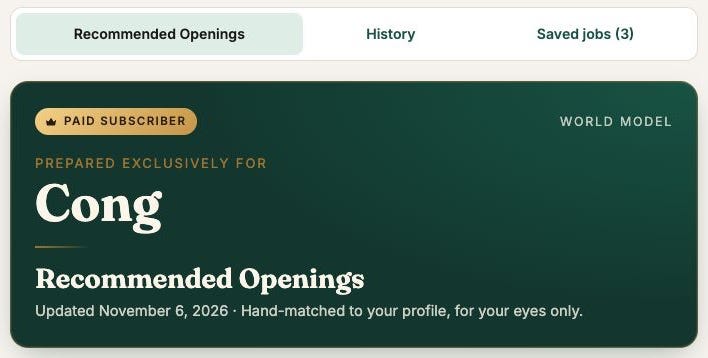
My own clawded.ai recommendation page. Each member has a separate page matched to their background; this screenshot shows the current interface.
Keep your next move in view
For project-based AI work, it helps to treat the next search as an ongoing part of the job. An active contract is a good time to understand your alternatives, while you still have room to be selective.
Mercor’s published guidance, for example, says ordinary project endings can follow completion, scope changes, or budget constraints, and that workers remain eligible for new opportunities. Eligibility leaves you with another practical question: which of those opportunities is worth your time?
This is where I want clawded.ai to reduce three recurring costs:
Finding opportunities: bringing potentially relevant roles from different platforms into one place.
Checking fit: highlighting the experience, location, schedule, and payment conditions you need to examine before applying.
Starting over: using your background and feedback to give the next round of recommendations a better starting point.
For example, imagine a trainer whose strongest work is reviewing business research. A recommendation asks for coding skills and a fixed full-time schedule. “I want research evaluation, I don’t code, and I have ten hours a week” gives me a much clearer basis for the next search than a résumé alone. It can also prevent us from spending attention on the same kind of mismatch again.
That feedback does not change an employer’s requirements or hiring decisions. It changes where we focus the search. The value I’m working toward is straightforward: less effort spent sorting through unsuitable roles, and a clearer path to the opportunities you can realistically pursue.
Here is how the two updates support that.
1. Tell me when a recommendation misses
The first addition is a thumbs-down option beside a recommended role, with space to explain why it isn’t a fit.
A missing click tells me very little. You might be busy. You might already have applied. You might have opened the listing and discovered a requirement that rules you out.
A short explanation gives me something I can use when refining future recommendations.
For example:
“The subject is right, but I can only commit ten hours a week.”
“This requires a qualification I don’t hold.”
“I’m interested in evaluation work, but I don’t want another coding assessment.”
“The role looks relevant, but the employer doesn’t accept contractors in my country.”
“Please look beyond this platform. I already have several applications pending there.”
These are examples, not quotes from members. Notice how each identifies a different problem. A qualification gap should change the search differently from a temporary scheduling conflict.
Once the new control is available on your page, use it when a recommendation misses. Add the reason if you can. Until then, you can send the same feedback by replying to a World Model email.
You don’t need to justify turning down a role. The purpose is to make your next list more relevant, rather than to persuade you to apply to the current one.
This is also how I want clawded.ai to improve: recommendations, your feedback, a clearer understanding of your needs, then another round of matching. A thumbs-down is useful information. It is not a promise that a replacement appears instantly.
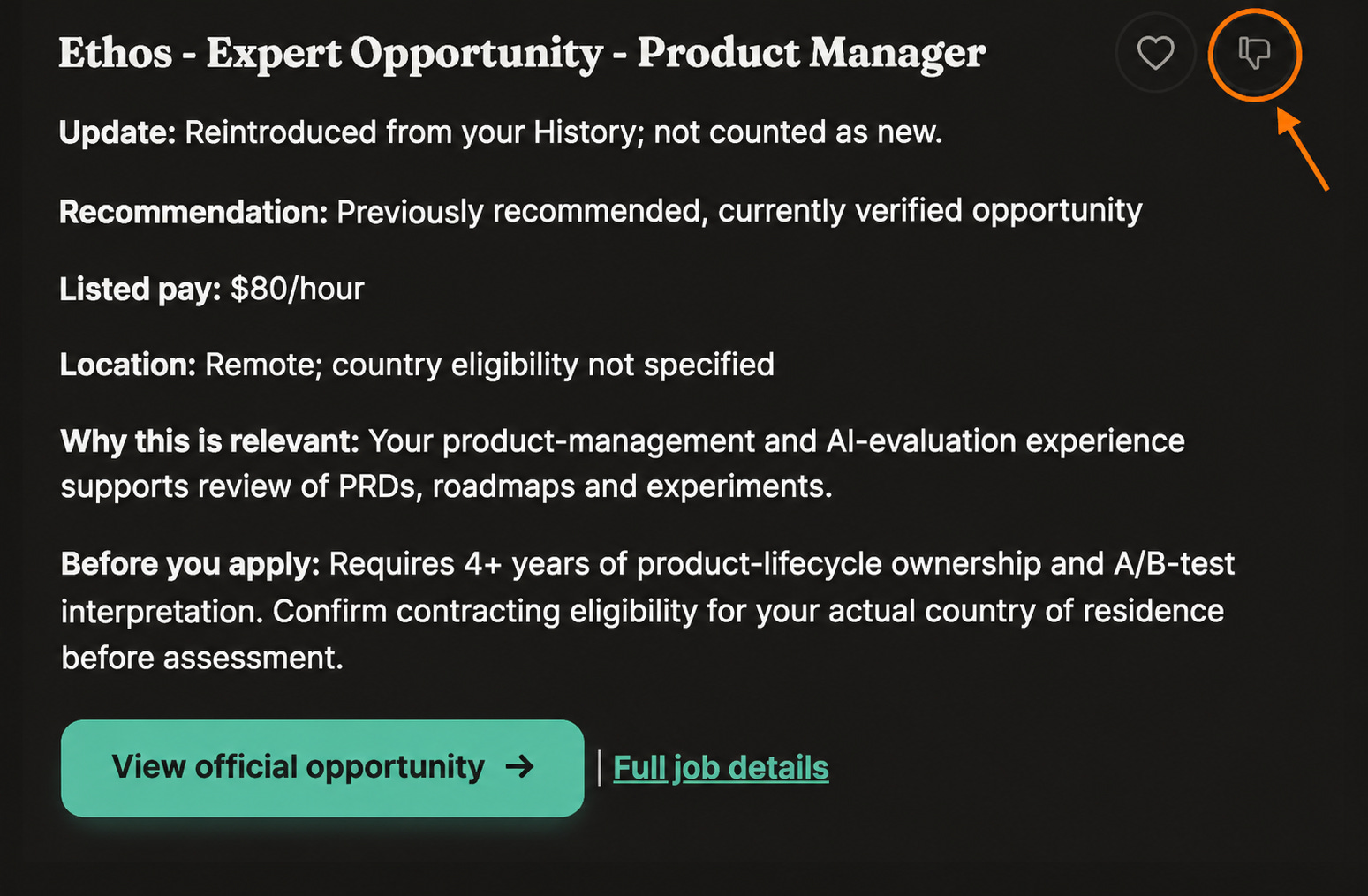
An example from my own page: the listed pay, location, matching rationale, and conditions to check before applying. This is a screenshot of an existing recommendation, not a claim that the opening was newly posted today.
2. Bring the recommendations into your inbox
I’m also adding daily recommendation emails, with direct replies as a simple way to give feedback.
The reason is practical. Remembering to check another website becomes one more task, especially when you are already balancing assessments, project work, and the rest of your life.
Your private page remains the place to review the recommendations. Email makes the update easier to notice—and gives you somewhere to respond while the details are fresh.
The most useful reply might be just one sentence: “I’ve started a new project, so please prioritize flexible work I can do alongside it.”
Or: “The second role is much closer. More opportunities involving research and writing would be useful.”
Daily updates should make it easier to stay informed. They should not create pressure to apply every day. Some days, the sensible action will be to check one promising role. On others, it will be to keep your current commitments and pass.
There also won’t always be a genuinely new, suitable opening. A daily cadence does not mean five new jobs every day, and an existing recommendation should not be presented as new just because it appears in another email.
A reply you can copy
If you want to help me understand what would be useful now, start here:
“My strongest areas are [two or three areas]. I’m looking for [type of work], and I can commit [hours per week]. I’m based in [country]. Please avoid [requirements or work I don’t want]. Of the recommendations so far, [role] was closest because [reason].”
You can also tell me if your priorities have changed: you have more time, you need a more predictable schedule, or you want to try a different kind of evaluation work.
Keep it about your experience and preferences. There’s no need to send confidential project materials, internal screenshots, or client information.
What this means for World Model readers
World Model is where I explain the work: how to prepare, interpret requirements, and make better decisions as an AI trainer or domain expert. clawded.ai is the practical companion: a place to find opportunities relevant to your background and refine that search with feedback.
For paid readers, access is included. If you are already a paid subscriber and haven’t received your login details, reply to this email and I’ll follow up.
If you are still exploring, these two guides are useful starting points:
Your Next AI Job May Not Be Called “AI Trainer” — a free guide to finding roles that fit your experience
You Know Your Field. Can You Show It in an AI Assessment? — a paid guide with worked examples and a preparation checklist
If personalized recommendations would help, you can join the paid side here:
A project can end for reasons you cannot control. With clawded.ai, the goal is to keep building a clearer picture of your next opportunity before you need to start looking urgently.
Tell me what fits and what doesn’t. Your next project may be new; your search should build on everything you have already learned.