

Fellow AI nomads,
The experts are busy with the big picture this month. Goldman Sachs put out a full conversation on how AI is affecting GDP growth, productivity and jobs. Its estimate for AI’s current net contribution to measured US GDP growth is about 0.1 percentage point.
It’s all macro. None of us can hide from it, and none of it tells you what to do on Monday.
Paul Millerd asked the personal version in July: will you train the models for pay? He doubted many people would want work whose only reader is a model.
My inbox says plenty of you do. On a personal level the question is simple. You can get paid to train models. I have been, on more than ten Mercor projects, as a contributor and as a reviewer.
Today I’m launching the tool I wish I’d had for that work. It’s called clawded.ai.
What’s different about remote work this time?
Remote work is old. Fiverr has sold gigs since 2010, and Upwork’s predecessors go back to the late 1990s.
My friend SH is an illustrator in China. On Fiverr, she drew the wedding illustrations for a couple in Indonesia.

She used AI to write to her clients in English, which isn’t her first language, and to keep track of the back-and-forth. Her delivery got better. The work was still hard. Work is work.
The old model has a simple shape. You sell a finished piece to one buyer. That buyer compares you with every other seller on the platform, mostly on price. Fiverr keeps 20% of every order.
That market is also shrinking for people like SH. A study of a major freelance platform found that within a year of AI image generators arriving, job posts for image creation fell 17% relative to manual-intensive work (Demirci, Hannane and Zhu). Fiverr’s own annual report says AI adoption is pulling its high-skilled and low-skilled services apart.
The new buyer is an AI lab. The lab wants her judgment about the picture: what makes a wedding illustration good, where a model’s version falls apart, and how to score the difference. That judgment gets reused every time the model draws. Mercor’s creative-roles page says creative professionals there earn $60 to $120 an hour, paid weekly.
So I told her to look at design roles at AI training companies instead. The four I named were Mercor, Handshake AI, micro1 and Surge AI. She applied that week.
Where you live decides which of those doors are open. Handshake AI requires US work authorization, and the work itself has to be done from inside the US. Surge AI doesn’t publish an eligibility list, and third-party reviews report that DataAnnotation, the open platform it runs, accepts six English-speaking countries. micro1 says it hires globally. Mercor sets location rules listing by listing, so read each one.
Should designers leave Fiverr and Upwork for AI training work?
My dear experts: delete your Fiverr and Upwork accounts. Do it on the day your first AI-lab project pays out.
Keep them until then. AI training work is spiky. Queues go quiet for weeks, and projects end early. The old account is your floor while the new work proves itself.
After that, stop spending your taste on gigs priced against every other seller in the world. Taste is what models lack, and it’s what the labs are paying for.
Is AI training work going to last?
Nobody knows, including me. Here is what I’d bet on.
Each time models improve, the easy tasks get solved and the remaining ones need someone more senior. The work moves up the expertise curve. It also gets smaller. A job became a project. A project became a stream of tasks, each with a timer. When the work is that atomic, finding the next piece of it becomes a big part of the job.
The demand is large right now. SemiAnalysis, quoted in Paul Millerd’s piece, reports that Mercor logged about 2.5 million expert hours in the second quarter of this year. That’s roughly 4,800 people working full time.
The skill that carries from project to project is the one Mercor’s CEO named on Conversations with Tyler: finding where the model makes a mistake. I’d add one thing. Explaining why, in writing, is what gets you paid.
What is AI training work actually like?
I know how it goes. I’ve done this work on more than ten Mercor projects. It is often exhausting. Some weeks it’s suffocating. This newsletter exists because of it.
Here is what readers send me, and what I’ve lived:
The queue goes quiet for three weeks, and nobody tells you why. I broke down the mechanics in Why Your Mercor Queue Went Quiet.
The matcher sends a radiologist a music-tagging task.
A stated $90 an hour becomes $25 once the handling-time cap bites. The AHT Game has the math. I have stopped my own timer when a task ran long, so my handling time wouldn’t flag me. I’m including that as a disclosure. The cap does that to people.
Projects end without warning. Business Insider reported last November that Mercor ended a large Meta project with more than 5,000 contractors, who had been told it would run to year-end, then offered similar work for $5 an hour less. Mercor called the report inaccurate without saying which part. In March, Business Insider reported that Handshake AI suspended contractors, told them the decision was final with no appeal, and paid four of the five it spoke to nothing for completed work.
The search eats months. In public forum threads I read this summer, one contractor listed the ten platforms she’d registered with. Nine produced nothing. Others describe one to five months from application to first contract. That’s contractor testimony, and I label it that way.
Some of this is the nature of project work. Every Mercor listing I opened for this post carries the same line: “Projects can be extended, shortened, or concluded early depending on needs and performance.”
Some of it is structure. You see one dashboard. The platform sees every project, every rate and every contractor’s numbers. When a project ends, the platform draws from a queue of replacements, and you start again from an empty one. That’s a weak position to bargain from, and most experts are in it alone.
What is clawded.ai?
clawded.ai is a job-matching tool for remote AI data work, incubated by World Model (world-model.xyz) community. It matches your profile to verified openings across AI training platforms, including Mercor, Handshake AI, micro1 and Toloka. Every opening is checked at the source before you see it.
World Model is the community. Every week, readers write to me about which projects paid, which went quiet and which listings were dead. clawded.ai is where that intelligence goes to work for one person: you.
The first thing it does is matching. A platform’s matcher exists to fill its clients’ projects. clawded.ai starts from your profile and looks across platforms.
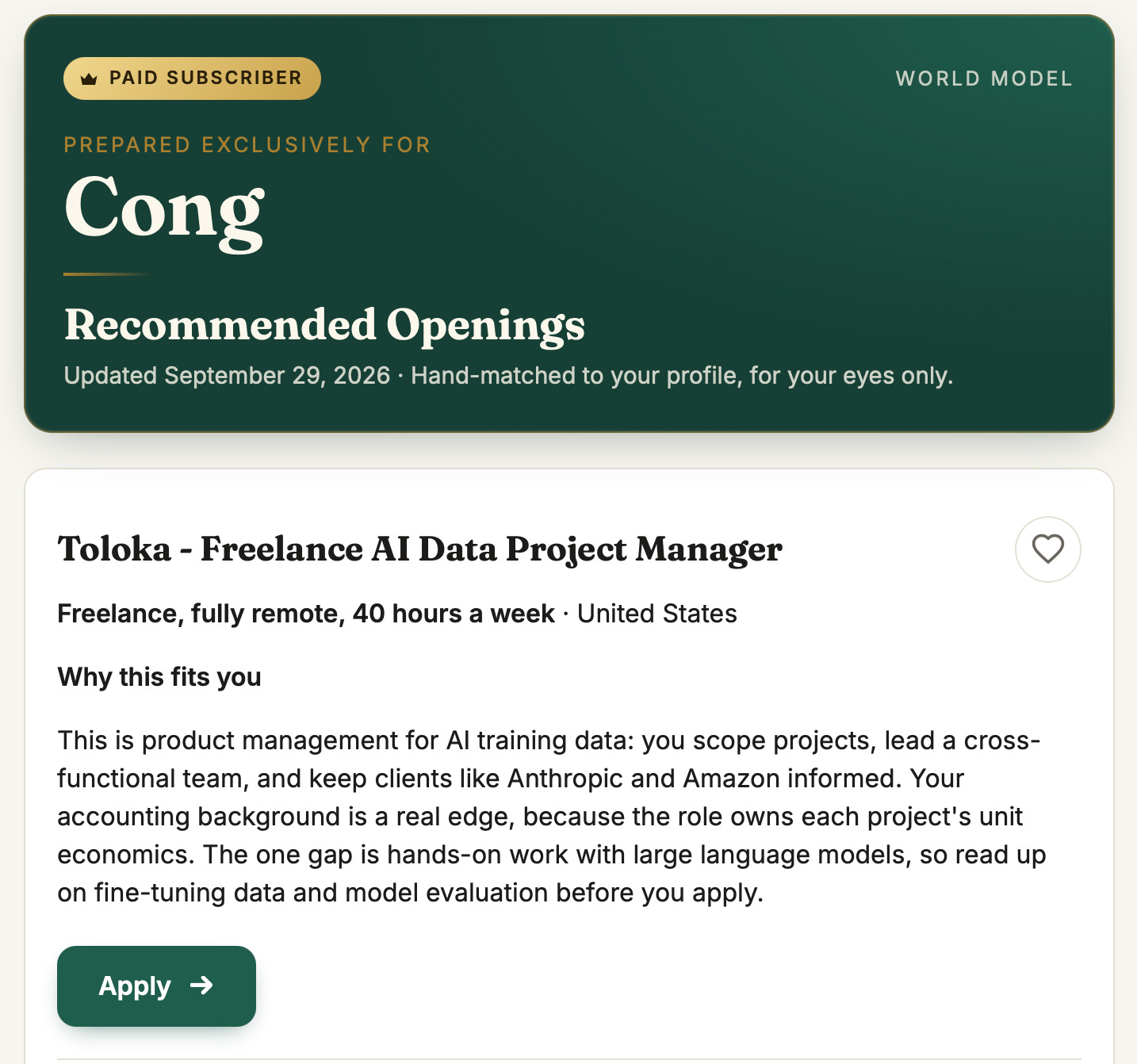
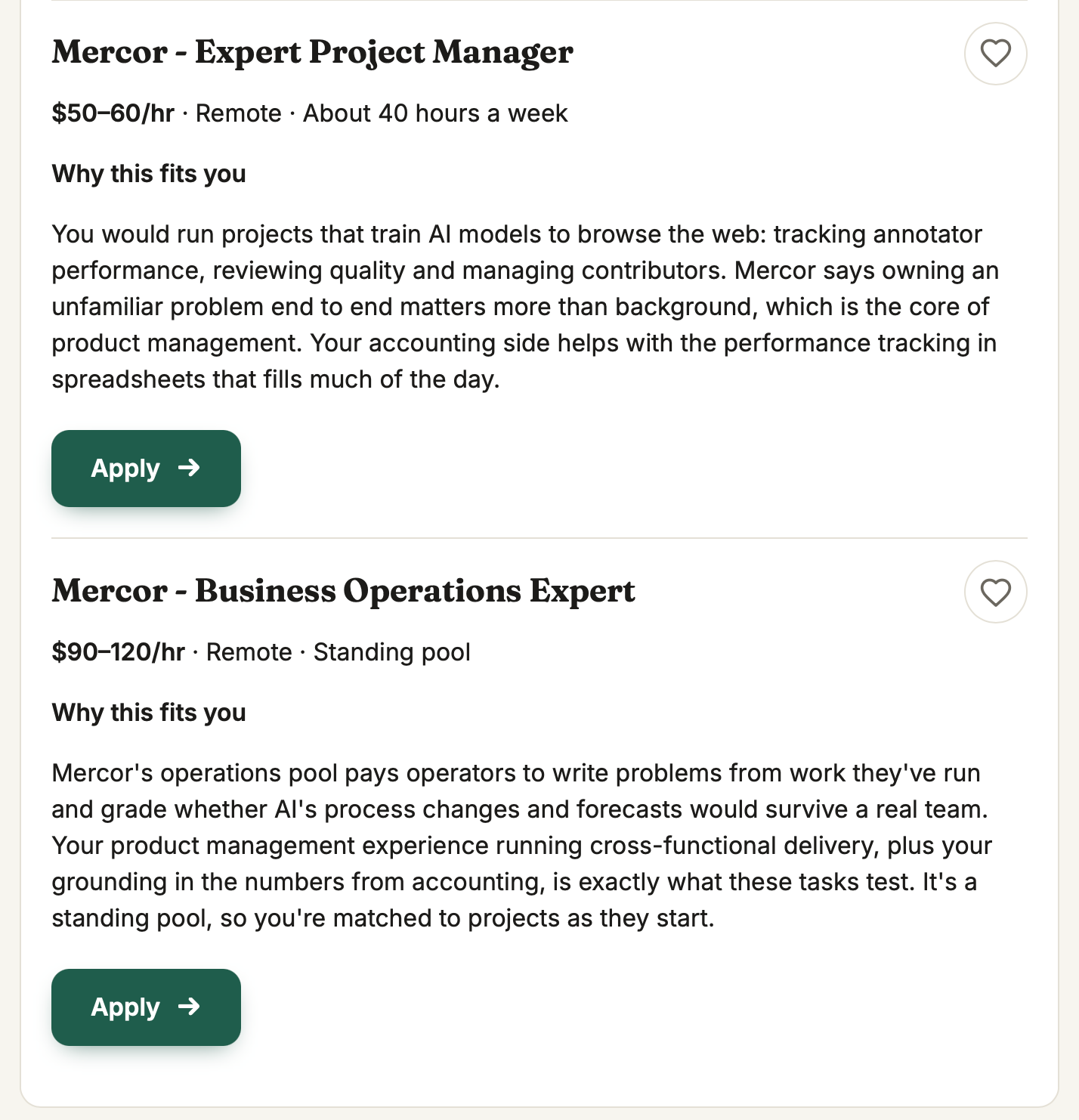
My own page, updated September 29. Each match says why it fits me and what gap to close before I apply. When I rechecked all three on September 29, #3 had stopped taking applications. That’s how fast this market moves, and it’s why every match gets rechecked.
What paid subscribers get in clawded.ai:
Three verified openings a day, hand-picked for your profile. Each one is taking applications on the day it’s checked.
Region screening. A role that needs US work authorization won’t be sent to you in Berlin or Bangalore.
Pay flags: handling-time caps and payment problems, noted where I know about them.
A save button, so you can come back to a role and apply later.
No form to fill in twice. It picks up what you’ve already told me in DMs and email. That information is used for your matches and nothing else, and I’ll delete it whenever you ask.
Your own private page, behind your own login.
Why is it called clawded.ai?
I’ve written before that experts do this work bare-handed. You find the listing yourself, check it yourself and apply alone. A claw is the simplest tool there is: something to grab with. clawded.ai is meant to be that tool.
How clawded.ai checks an opening
World Model (world-model.xyz) checks every opening before it reaches clawded.ai. An opening counts as verified when it is taking applications on the company’s own careers page or applicant system on the day it’s checked. Region locks, payment rails and handling-time caps are noted when the listing or reader reports show them. For this post, on September 29, 2026, I rechecked the three openings on my own page and five Mercor design listings. Three of the eight had closed. Anything that fails the check doesn’t ship.
How does clawded.ai work?
I check openings in public every week. Paid subscribers get the same work done for one profile: theirs. clawded.ai is in beta, for paid subscribers first, and it will open wider later.
Reply to the email I send you with three things: your background, where you live and are allowed to work, and your resume. New paid subscribers get that email right after joining. Already a paid subscriber? Mine is on its way to you this week.
I reply with your clawded.ai login. Your first matches will be waiting.
Everything else paid subscribers get stays. The insider posts continue. Past ones include the Hands-On Mercor Playbook (one reader followed it to $37,000 in four months), the Mercor profile prompt from AI Tools for Nomads #1, The Mercor Location Trap, and the Inside the Data Factory series. The prompts from those posts are being built into clawded.ai.


You are not alone
Working for an AI lab from a laptop can feel like working for nobody. A project ends, the Slack goes quiet, and there’s no one to ask.
There are over 26,000 of us here, spread across the world and across Mercor, Handshake, micro1, Surge AI and the rest. You’re not alone in this, and you shouldn’t have to do it bare-handed.
PS: If you’re outside the US, Handshake is closed to you unless you live and work there. micro1 says it hires globally, and the Mercor design study above states no region lock. clawded.ai screens every match for where you can actually work, so you stop opening US-only listings.
FAQ
What is clawded.ai? A job-matching tool for remote AI data work from World Model (world-model.xyz). It matches paid subscribers to verified openings across AI training platforms such as Mercor, Handshake AI, micro1 and Toloka.
Who can use clawded.ai? World Model paid subscribers, anywhere in the world, during the beta.
Does clawded.ai work outside the US? Yes. Every match is screened for where you live and are allowed to work, so roles that need US work authorization, like most Handshake AI roles, only go to readers who can take them.