

Fellow AI nomads,
Suppose you have an hour tonight to look for your next AI project. You find a promising rate, a familiar platform and a job title that sounds close enough. Twenty minutes later, you discover a location restriction. Another role asks for experience you cannot demonstrate. A third looks useful, but you lose it among your open tabs.
Before you spend another evening applying, you need a way to decide which opportunities deserve your time.
Today I’m sharing an upgrade to clawded.ai, the personalized AI job-matching service I’m building for this community. It is currently available exclusively to paid subscribers of World Model. If you already subscribe to either, this is part of your paid membership.
This post is free to read. Below is a screening method you can use immediately, followed by a walkthrough of the member experience.
Which AI training jobs should make your shortlist?
Before preparing an application, answer three questions.
1. Can I actually take this work? Check where the work must be performed, work-authorization requirements, required availability and any restrictions on concurrent work. “Remote” alone does not answer these questions. If a requirement is unclear, put it on your question list before investing in a lengthy assessment.
2. What evidence makes me a credible fit? Name something concrete: a relevant project, a tool you use professionally, a domain judgment you can explain. A broad title such as “AI trainer” tells you less than the tasks underneath it. Could you evaluate a translation? Identify a flawed editing workflow? Explain why a technical answer fails?
3. Is the next step worth the time? Look at the assessment commitment, expected hours, payment basis and information still missing. A published hourly range does not tell you how much work will be available. Decide what you need to clarify before committing more time.
For each role, write one sentence:
“This fits because ____. Before I apply, I need to confirm ____.”
If the first half is vague, reconsider the match. If the second half contains a deal-breaker, resolve it first.
What a useful match looks like
Consider an illustrative example: a video editor deciding between a broad coding role and a role involving video evaluation.
For the video role, they may already have evidence: a reel, experience diagnosing pacing problems, and the ability to explain why an edit works. The coding role might also be relevant, but only if their programming experience supports what the listing asks for.
The useful recommendation explains that distinction. It should help the reader decide what to prepare and what to ask, rather than leave them with another application link.
That is the standard I’m aiming for with clawded.ai: a clear reason to consider an opportunity, plus a sensible next step.
Inside the updated clawded.ai experience
Here is how to use the updated member experience, from your latest recommendations to saved jobs and earlier matches.
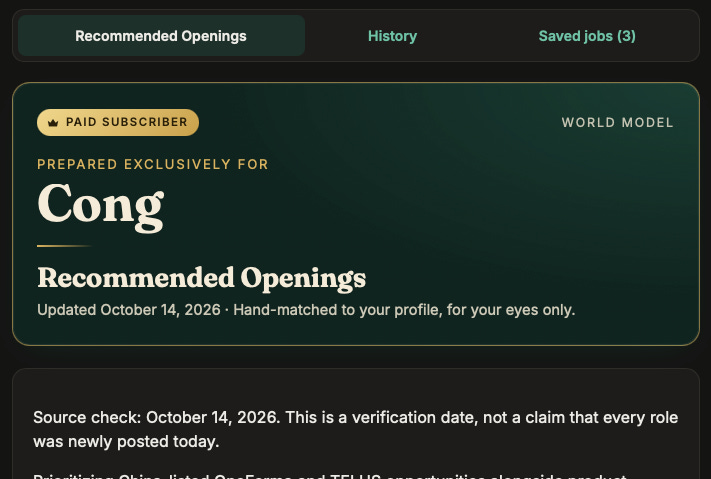
Start with your recommended openings. Your private page connects roles to the background you have shared. Recommendations explain why a role may fit, what evidence to prepare and which conditions to confirm. A match can also identify a gap that makes an opportunity a lower priority.
Read through to the source. Follow the job details and official application links. Check the requirements and the date of the recommendation before acting. A listing accepting applications when checked is still not a promise of an offer, available tasks or a start date.
Save the roles worth revisiting. Use Saved jobs for opportunities you want to return to after preparing a sample or resolving a question. Keep your shortlist focused on roles you have a specific reason to revisit.
Return to recommendation history. Revisit previous recommendations as your availability or priorities change. Treat an older match as a starting point to recheck, rather than evidence that the opening is still live.
A 15-minute routine for your next opportunity
You do not need to spend every evening searching. Try one short review each week:
Five minutes to screen. Read your recommendations and apply the three questions above. Set aside roles that fail a hard requirement.
Five minutes to choose. Save the strongest one or two. Identify the evidence you already have and the question you still need answered.
Five minutes to plan. Choose one next action: review the application requirements, prepare a relevant example or ask for clarification. Put that action on your calendar.
The fifteen minutes are for deciding what comes next. Preparing a good application will often take longer. A focused shortlist gives that preparation a purpose.
How to get your personalized page
Already a paid subscriber to World Model? If you have not received access, reply to this email and let me know. Include your strongest area of experience, where you work and your work authorization, the platforms you already use, and the kind of opportunity you want next. If your situation has changed, send me an update so your recommendations can reflect it.
Currently a free reader? A paid World Model subscription includes two connected benefits: the practical guidance in the paid archive, and access to clawded.ai for recommendations based on your own background.
Upgrade to World Model paid membership
Previous highlights to put those recommendations to work:
You Know Your Field. Can You Show It in an AI Assessment? — prepare to make your expertise visible when an opportunity reaches the assessment stage.
The Mercor Profile Prompt — revisit how you describe your background and relevant experience.
The Mercor Location Trap — understand why location deserves attention before you invest in an application.
I’m continuing to build clawded.ai around the decisions you actually face. Reply with the part you find hardest: finding relevant roles, judging the fit, preparing evidence or keeping track of opportunities. That feedback will help shape what I improve next.